
To preface, this won’t be an article about why everyone deserves forgiveness for anything they’ve ever done. People draw boundaries for a reason, and purposefully crossing boundaries is not something that passes the sniff test for forgiveness.
This article is about why it is important to forgive as a general rule, and I do mean that it is important to forgive even without apologies or retributions from a guilty party. I will say before we dive in that I break my own rules all the time, and am welcome to the idea of being called a hypocrite.
Let’s begin with game theory.
Game Theory Optimal
Game theory gets a lot of attention in popular media because of how it plays into poker, behaviors, etc. And it’s almost always presented as some extremely complicated, mathematical analysis tool that geniuses uses to model human behaviors and get an edge. With a name like game theory, it makes sense. The branding is great, it rolls of the tongue, its even got a hint of mystery.
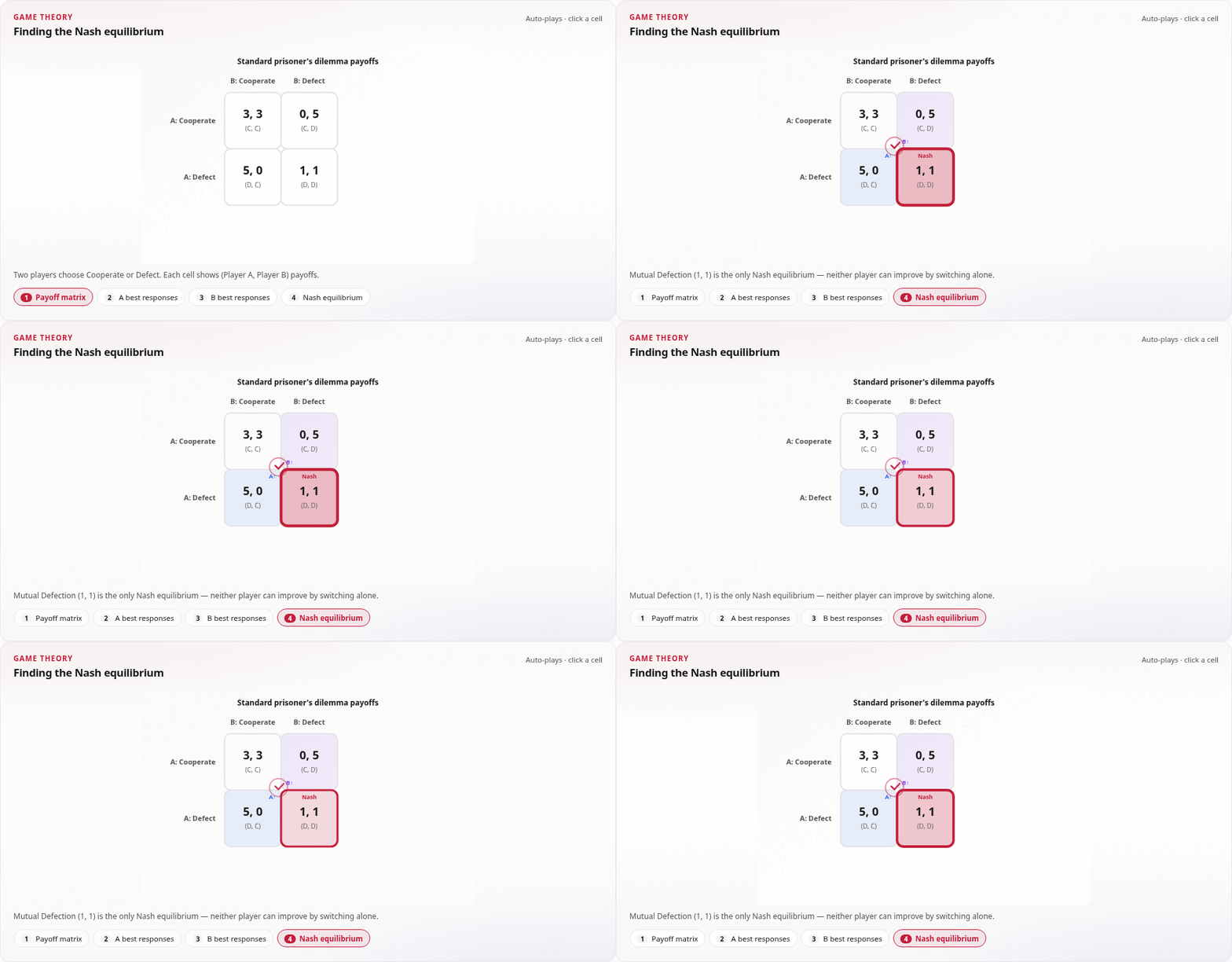
The goal of game theory is simply to model behaviors with simple games. The best choices in the game indicate the behaviors that are best for reality. Part of game theory is modeling utility which is a substitute for everything a person could care about from preferences to money, the whole spectrum of reality. Each person is a player, a rational agent, seeking to maximize their utility via some set of actions. Initial forms of game theory were just tables, but this naturally evolved into trees and equations to capture more complex interactions.
One of the first games, illustrated above, is the prisoner’s dilemma. The original prisoner’s dilemma problem is a one turn game where two players either cooperate or defect; cooperate is to not rat out your co-conspirator of a crime, and to defect is to betray your partner in crime and attempt some kind of snitching plea deal. Naturally, if both cooperate, they do better than if they both attempt to betray each other. But there is a snag, if only one person defects, they reap an extreme reward indicative of being able to not go to prison at all while the partner in crime is punished alone.

Image © Showtime. Key art via Wikipedia

The iconic game we are most interested in is the iterative version of the prisoner’s dilemma proposed and studied by Robert Axelrod, likely the reason for the name of the main character in Billions. The story of this research was that Robert Axelrod invited a bunch of game theory afficionados to create strategies in the form of computer programs, and had those programs duel against each other in round-robin tournament formats. The core difference between this problem and the original prisoner’s dilemma, is that the players played more than one turn of the game, so what a player does in one turn can affect future turns. There were a ton of strategies, and those are discussed in depth in The Evolution of Cooperation, Axelrod’s book.
There was a simple strategy that prevailed in the tournaments against far more complex strategies that were known for exploitation. This strategy is known as “Tit For Tat” and was created by Anatol Rapoport.
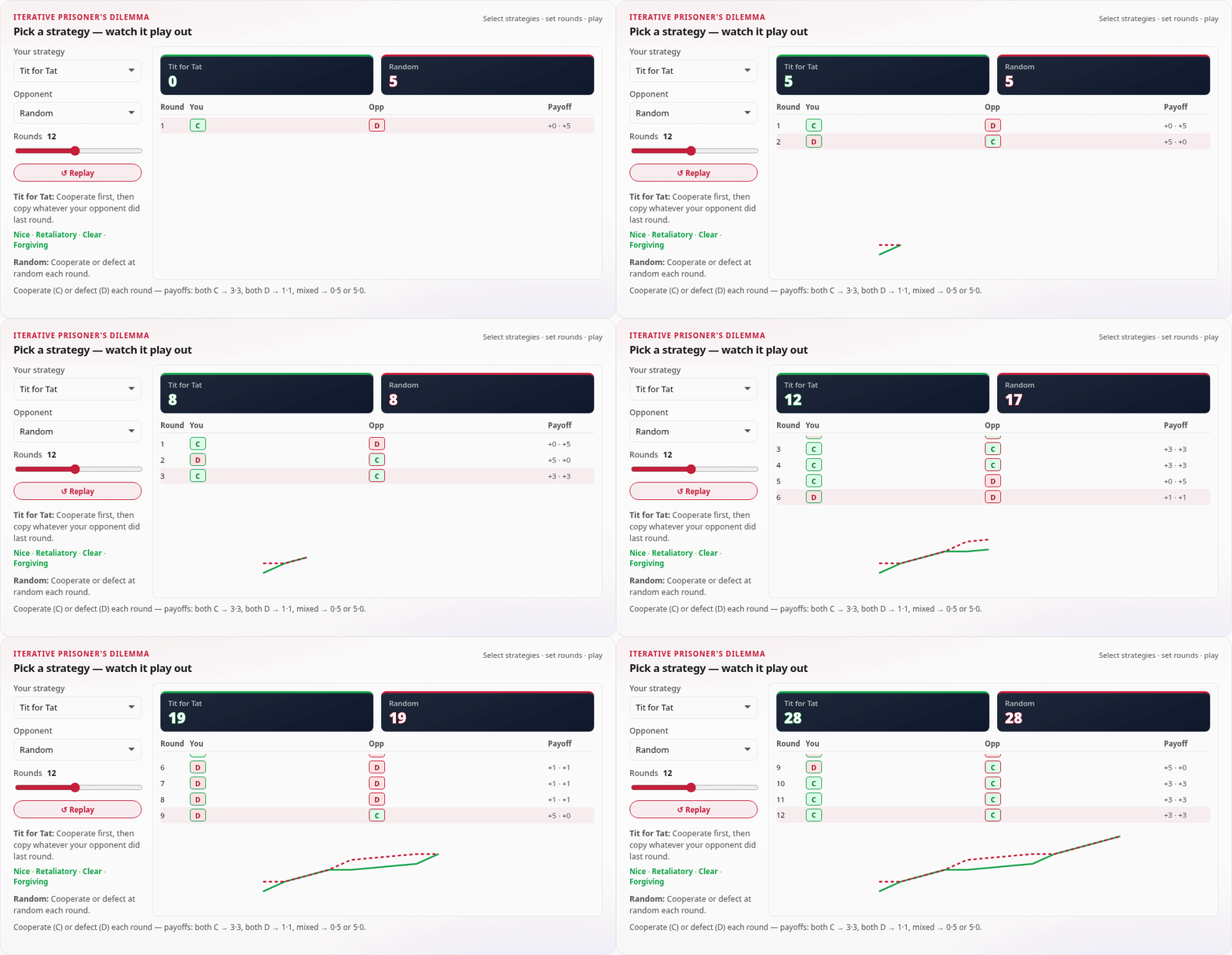
The strategy was made up of two parts. First, cooperate on the first move. Second, do whatever the opponent did last round. When analyzed by Axelrod, he distilled the problem down to four ideas. Tit for tat is nice, retaliatory, clear, and forgiving.
It is nice in that it doesn’t start the fight; it starts by being cooperative. It is retaliatory in that if it is wronged, it will punish in response so that it is not exploited for free. It is clear in that sophisticated programs can easily understand the intentions of the algorithm. And, to the point of the article, it is forgiving. Once the opponent cooperates, it will begin cooperating again.
There are, of course, caveats to the story. Tit for tat was the best performing in round-robin meaning that it was best in overall performance, not unbeatable by every specific strategy. There was also follow up research indicating that for more elaborate scenarios there are variations on tit for tat that are better.
But, the idea is pretty clear. Even without an adult or parent in the room, two rational self-interested agents may become cooperative because it is beneficial for both of them. Chef’s kiss. Fade to black.
Just kidding. If that was the only thing I wrote about, then I’m no better than a Veritasium video from over two years ago.
Exploitation and Punishment
Forgiveness for a Reason
One of the parts of tit for tat that is often glossed over in favor of highlighting the forgiving and nice nature of the algorithm is the retaliation part. Forgiveness doesn’t always come without a cost to the guilty party. The tit for tat algorithm is not preaching a holier-than-thou ideal where you dole out forgiveness for nothing. No, if anything, it is actually brutal in that it’s an algorithm that punches back just as hard as it is punched.
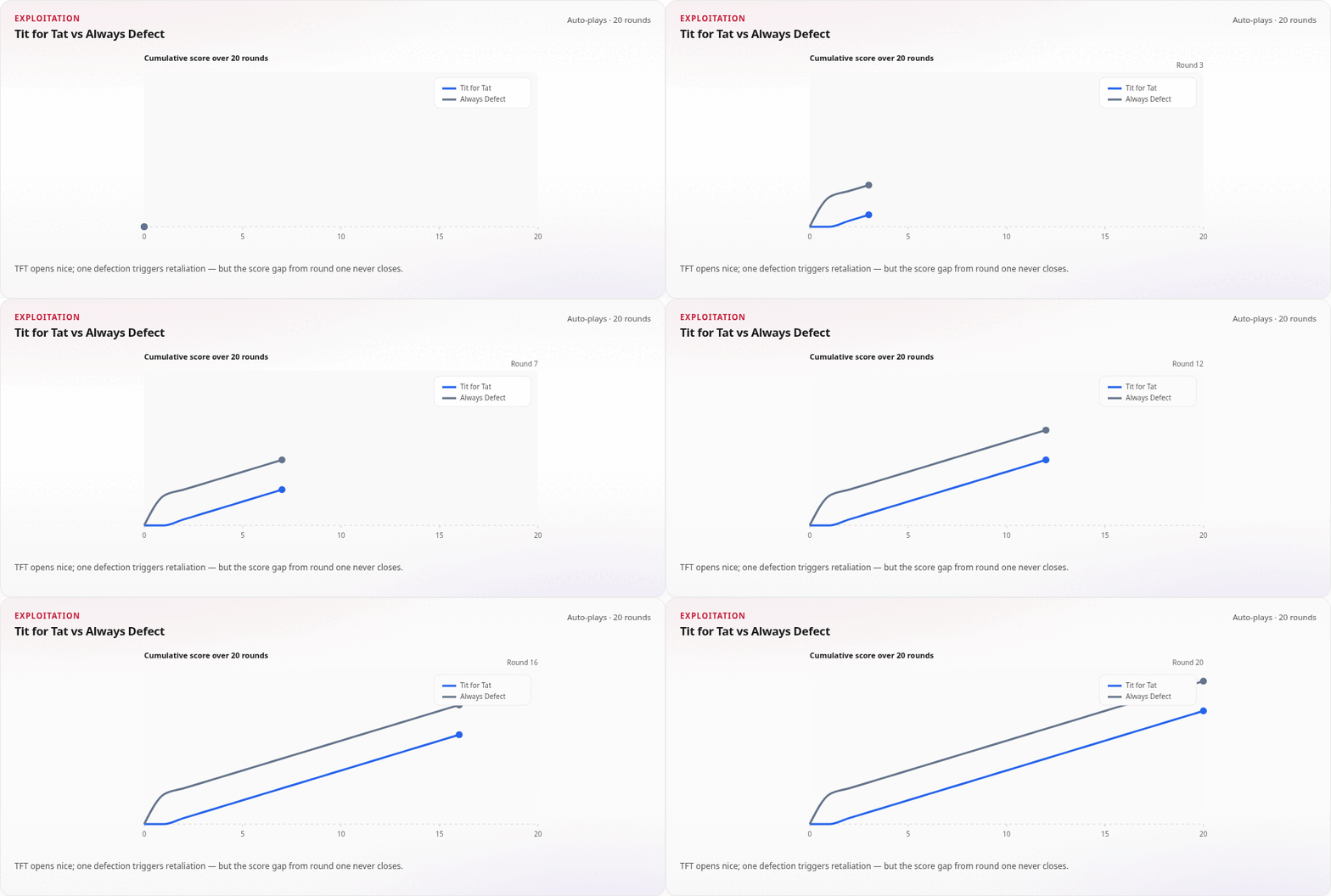
It also loses to the most egregious algorithm, which is the one that seeks to defect with no remorse, as it loses on turn one and is never able to catch up.
If anything, this teaches an additional lesson that is a bit less savory; it is simply not an option to forgive those who do not seek to cooperate. Which seems obvious. It probably should be. But in real life, I think this manifests in ways that are a bit more nuanced. Cooperation isn’t truly a one-dimensional action. It’s not simply a choice. People’s actions are based in value systems and with conflicting interests and self imposed constraints. A person may defect and not even realize they are defecting. They are just cooperating with themselves. The analogy really falls apart fast.
Some people will have lives inextricably linked to your wellbeing with value systems that are not completely orthogonal to your own, but they might as well be. (And that’s okay!) But if they differ in direction enough, then you may find yourself in this iterative prisoner’s dilemma with quite an egregious opponent. It may mean that you have to give up on the idea of cooperating with them and seek a different route of behavior. Otherwise, you’re just in a situation where forgiveness just leads to inadvertent exploitation. And we wouldn’t want that.
After all, we have graphs we need to maintain.
The Social Network

Poster © Columbia Pictures. Image via Rotten Tomatoes.
The idea of a social network loosely began in the 1800s, with the advent of modern sociology. Émile Durkheim and Ferdinand Tönnies created models of how human relationships transformed through the industrial revolution where small, rural villages that were tight knit with shared values, kindship, and organic closeness became industrial cities where social ties were based on self-interest, contracts, and other yucky things. The networking part came around in the 1900s with Georg Simmel, who imagined society not as individuals or fixed groups but as webs of people. The term social network was finally coined in 1954 by an anthropologist by the name of J.A. Barnes when writing about a parish on the Bremnes island, in Norway.
There’s a lot more to the history, but possibly the big landmark work was The Strength of Weak Ties by Granovetter in 1973. Its hugely cited and it’s quite the paper. The core demonstration of the paper was that even loose acquaintances, were valuable for things like ... finding jobs. (And the LinkedIn connects go wild!)

Jobs, connections, etc. Valuable things can come from loos ties, all the things that people talk about before networking events.
Something that isn’t talked about as much on social media or at these networking events, is the breaking of network connections. People lose friends. They lose connections to coworkers. They drift apart. Weak ties are easy to break; they also don’t naturally persist in a world rife with conflict.
Yeah, yeah, I’m being heavy handed. Forgiveness does in fact help with that.
Your friends have more friends than you
In 1991, a sociologist named Scott L Feld, observed the friendship paradox. In summary, your friends are likely to have more friends than you. Its mildly unintuitive, and has a lot to do with how popular people have a lot of connections and those people don’t have nearly as much popularity.
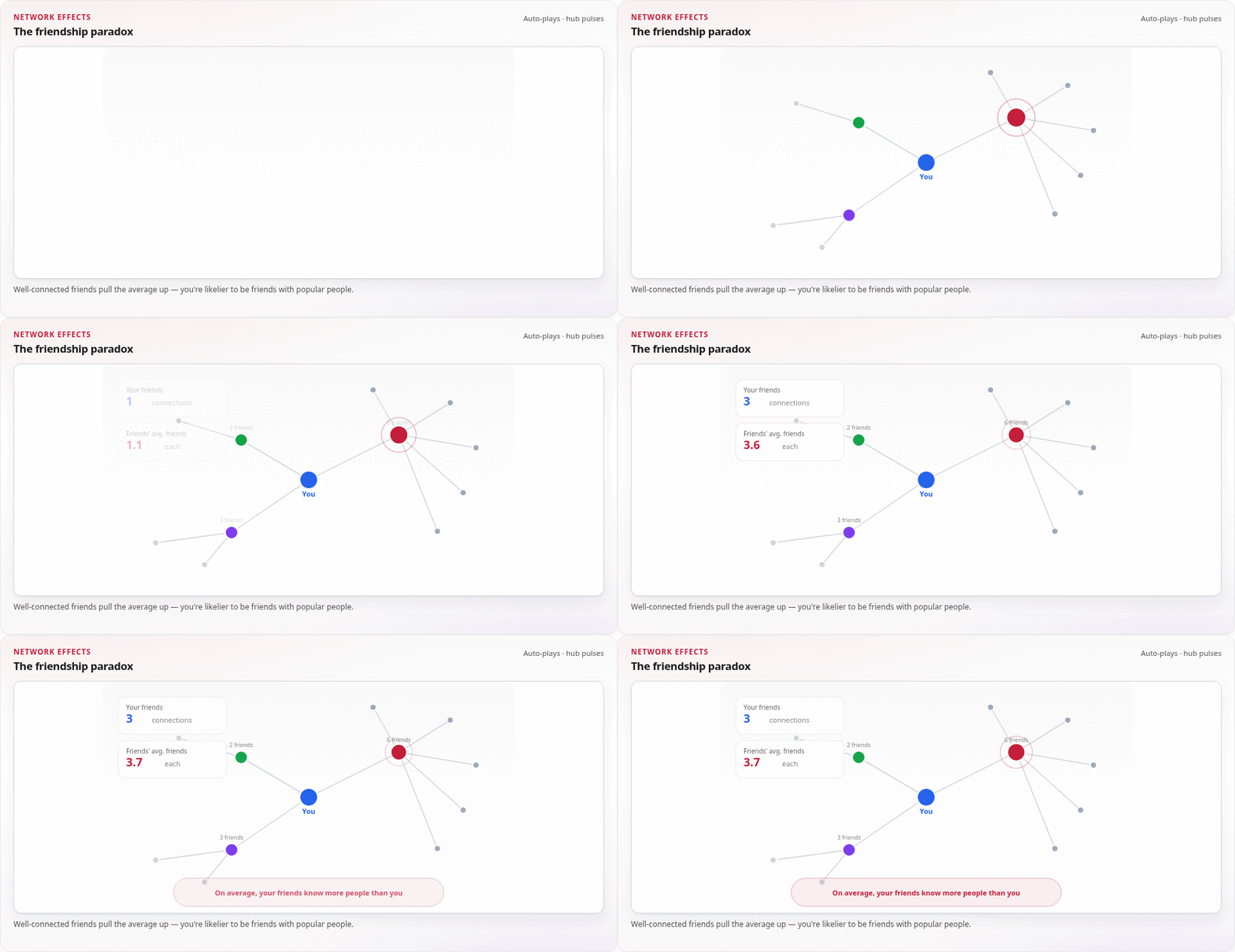
In mechanical engineering, a lot of time is spent discussing leverage in the form of gear ratios and moment arms. In a lot of ways, friends and social ties are an individual’s intellectual leverage.
Stemming back to as early as I can remember, every group project I’ve partaken in is a slightly sadistic, slightly masochistic game. For the group projects where a teacher decided the groups, I can’t believe you would do that to me. For every group project I had with friends that carried me, I can’t thank you enough.
It feels a bit silly to have an entire section of this article being about how important it is to have friends that are invested in your well-being and forgive you for your faults and that you in turn forgive for their faults so that you can all grow together, but it feels necessary as an adult. I have friend groups span continents and that is in fact a flex. I’m proud of my friends. I often brag about them. Here’s a famous video of one of them:
I link everyone I know at the first chance I get because it truly is amazing.
And the best part is that he forgives me every time.
(Do Not) Stick to the Status Quo
Most of this article has been about the importance of forgiveness and the value that comes from forgiving. At its core, the idea is that cooperating with people that want to cooperate is valuable and forgiveness enables that.
I do want to add a slight specification. There’s no need to participate in insanity. Just because you forgive, doesn’t mean you have to do the same things over and over. The action space you have in life is far larger than cooperate or defect and you should treat it as such. Being forgiving is a quality that enables you to work with a person again, but that doesn’t mean you have to work in the same way. You’re allowed to change the dynamic so that you don’t have to deal with the same issues of defection again.
And possibly most important to all of this, forgiveness should be something that causes a change in your behavior. You shouldn’t treat relations the same way before and after you are wronged. As a principle, its pretty clear and obvious. It would be insane for a person to keep acting business as usual, maintaining the status quo, after being wronged.
I emphasize this part so much at the end, because this rule is something I have such a difficult time enacting in my own life. Forgiveness with no behavior changes is simply yearning for a time before any wrongdoings and misgivings. I’ve found myself recently in a situation where I tend to be doling out forgiveness rather than apologies more often than not. Lucky me. And in this circumstance, I find it difficult to not wish for the times before the forgiveness was required and yearning for the relations that did not require me to change and alter my behavior to accommodate for previous misgivings.
But alas, that’s life.