
These questions have been popping up a lot to me lately, primarily because the first batch of high school students I mentored while in grad school have wrapped up with college. I imagine it also has something to do with the number of people being very vocal about dropping out of college and graduate school to create AI startups, and the new Silicon Valley adoption of 9-9-6. Despite being clearly different questions, there is a similar level of nuance and it can be difficult to answer all the meaningful angles.
So first, let’s just talk about why people go to grad school.
Barriers and Signals
Graduate school for some jobs is required. If you want to become a doctor or a lawyer, you have to go to medical school or law school respectively. In those cases, going to grad school is quite literally breaking down a barrier to entry. Its table stakes.

Table stakes. Photo via Wikipedia

The same could be said for a career switch. Not long ago, an assortment of people flooded into coding boot camps and masters programs in computer science to initiate a career switch into big tech. Again, its table stakes, but in a very different way. For those people, the barrier wasn’t fully constructed.
I think when thinking about how to get a job, its beneficial to think about the other perspective: what a company wants when hiring a new employee. There’s a sort of mythos that’s been created around the process of hiring now because of how obfuscated its become with AI automation across the application, the evaluation, and even the interview process especially around big tech and large organizations. However, the objective of hiring can be boiled down to a company needing a person with a skill set that can do a thing for the company. The hiring process is built around fulfilling this objective and de-risking bringing in a person for that role. I write de-risk because every time a person is hired, there is some level of risk for a company. At startups, especially early on, a bad hire can bring down the entire company.
So for a person who’s sole goal is to get a job offer, the goal would be to create a clear signal that you both:
Have the matching skill set that the company is looking for, and
Are not risky at all if you joined the company.

A game of risk. Photo via Wikipedia

It then becomes very clear how grad school fits in with this mental model. The credential you receive from grad school is your way of creating a signal that you are the right fit. After all, having an education indicates that you have the ability to learn, and throughout your education you probably picked up a skill or two that is in the skill set that the company is hiring for. In that regard, grad school should be a no-brainer. But it isn’t anymore.
Signal to Noise
Because we’re talking about signal, its immediately important to talk about noise. (Or at least maybe I just think its immediately important because of the engineering/controls background.)
In this case, noise comes from a lot of places. A person’s personality, the way they speak, how their resume looks, and even the way a person dresses can provide noise to the signal. That is all stuff that a person controls though, for the most part, so its not particularly worth talking about.
The thing that’s outside of their control is the perception about their education.
Something that has been mentioned to me a lot, probably more than I’d like, is UC San Diego’s recent issues with math skills in their freshmen class. Now a lot of that is completely irrelevant to me now, given the graduate degree I have, but there are jokes about how it devalues my degree. That’s the problematic noise that comes with education.

surely this spaceship library will raise their math ability
Unsurprisingly, this topic has been researched fairly extensively. In fact, it won a Nobel Prize.
Rat Race Equilibrium
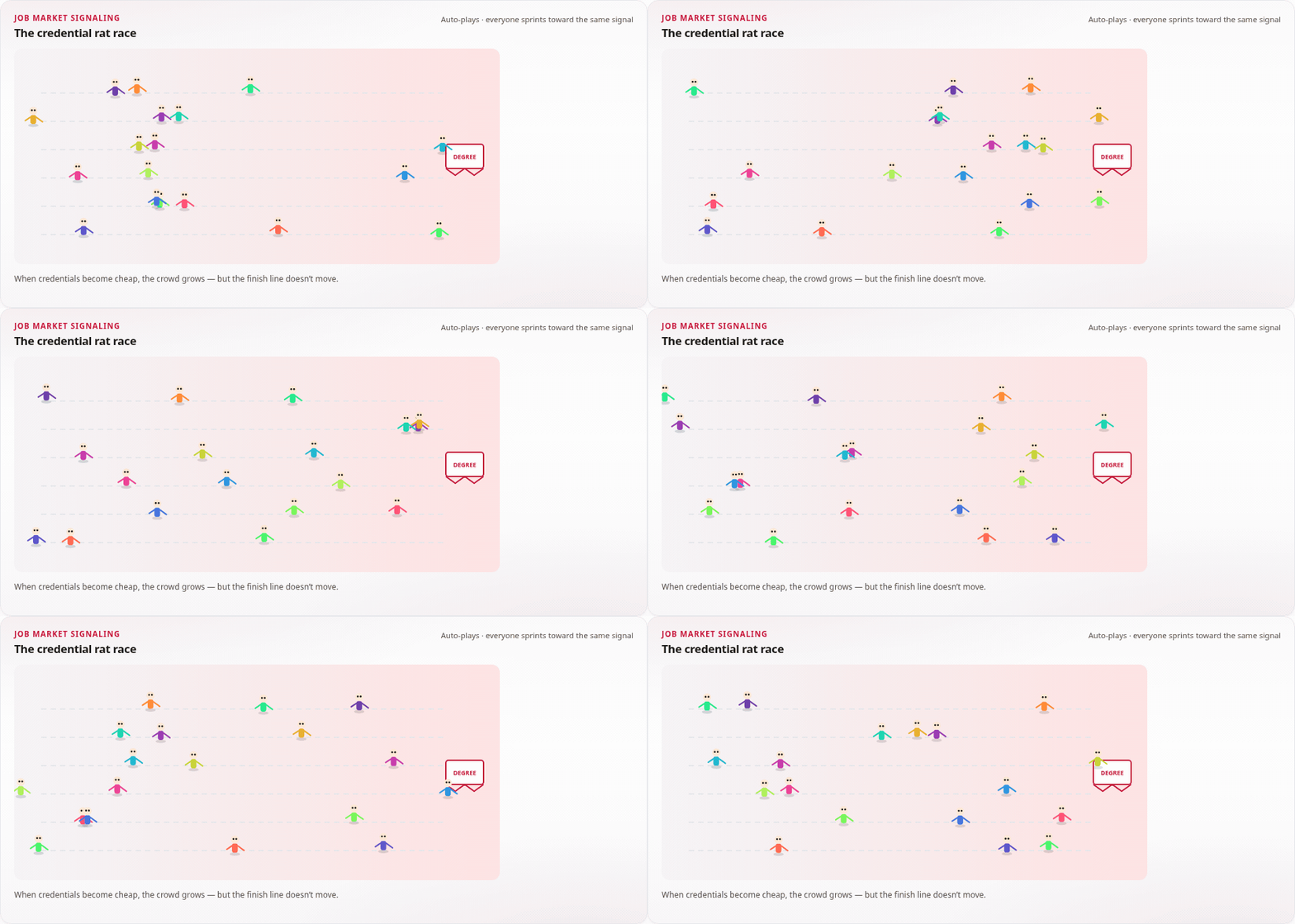
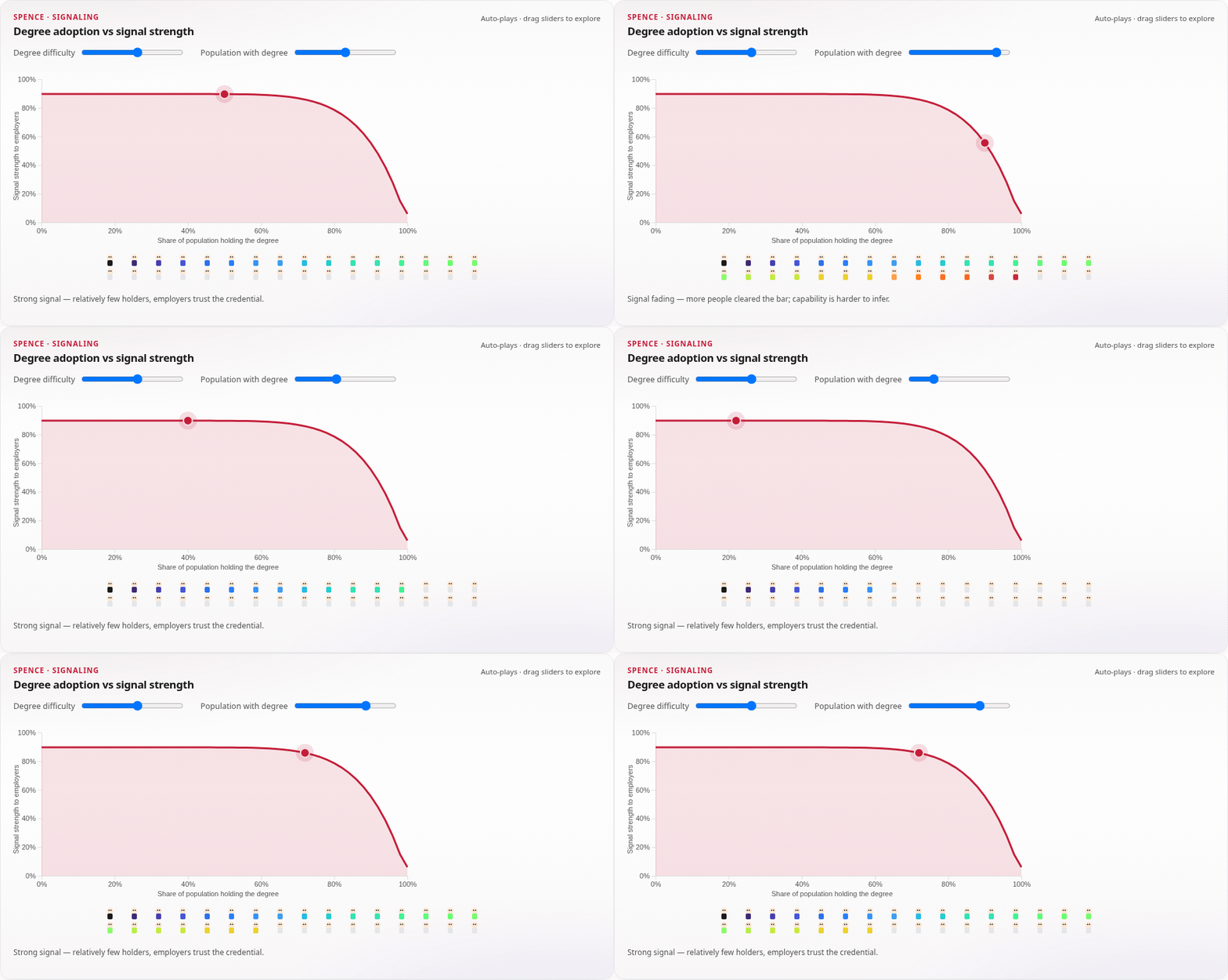
The research paper, titled “Job Market Signaling”, was written in 1973 by Michael Spence. The core idea of the paper is that education doesn’t always increase the productivity of an individual, but it does act as a market signal for employers that the individual is “capable” because only “capable” people can get the degree at a reasonable cost. “Reasonable cost” does a lot of heavy lifting here. There is of course the monetary cost which is what people naturally think of, and the opportunity cost which is usually the second thing to come to mind as a person chooses to do school instead of just getting a job for experience. But there are other costs to consider, like strain to mental health, physical health, and even health of a person’s relationships. All of those are wrapped into the idea of cost.
With that in mind, if a degree is “cheap enough” such that non-”capable” people are able to obtain the degree in large enough numbers, the degree becomes useless as a signal for capability. However, because of the degree’s history as being a useful signal, all people are now forced to obtain the degree just to match the credentialing of everyone else. And thus, we enter into a credential rat race. This topic is discussed pretty significantly in The Case Against Education by Bryan Caplan.
Skill Acquisition and Productivity
The idea of “Job Market Signaling” is one that really hinges on productivity not being increased through education, which I’m sure resonates with a lot of people, especially those that hated math from a young age. Formal education, in general, is pretty loss-y in terms of skill and knowledge transfer but its not really guaranteed. I can say though that a lot of the work I did in graduate school, both in classrooms and in formal education have served me very well in my career in terms of being able to look at ambiguous problems and understand how to format them in a way that is solvable through the set of skills I’ve developed.
However, there are a lot of skills I’ve developed outside of the workplace and also outside of education. I actually owe a lot of my productivity to the education I provide myself in my own time. That feels very much like the missing piece in the question of “Should I go to grad school?” There’s an unknowable factor for the me when I try to answer the question for anyone other than myself. I don’t really know your work ethic, your ability to retain knowledge in a formal setting, your ability to transfer skills that maybe nuanced when attempting to transfer them, your motivation to learn material outside of what you directly intend to work on, or, maybe most importantly, the opportunities that may arise for you specifically if you don’t go to graduate school. Sure, I think there’s some expected value from a PhD, but the variation in returns is pretty massive.
Kind of portraying the opportunity cost issue, people have demonstrated that learning on the job can be pretty consistent in providing useful career-oriented skills. In some regards, learning on the job or creating numerous side projects to highlight your skills can be easier to digest and less amorphous for an employer. It also is fairly consistent in the job market to stop caring about a person’s education after they’ve worked a few jobs, as the jobs tend to be a better representation of how someone will work at a new company rather than their education. Maybe its obvious to say, but there are surely ways of highlighting yourself and your capabilities without having to dedicate a line of your resume to a degree. There’s simply cleaner signals that exist.
None of this is to say I don’t recommend going to graduate school. Actually, I’ve recommended it to a handful of students even when they were in high school. There’s one in particular that comes to mind, as I recommended they should go do a PhD while they were still a senior in high school. But even for those recommendations, I acknowledge that I’m mostly guessing at whether they will benefit from the situation and gain the ever sought after “productivity gain.” After all, the world changes a lot.
“Enough” is Enough
The question “Am I working enough?” is very similar to the grad school question. Its about perception: am I exhibiting a signal that says I’m being a productive worker through the amount of time I spend on work-related activities?
Also a question, I am completely incapable of answering for people in most situations. It is an interesting question though, because it comes at a time where perception of effort has seemingly become top of mind on social media. It is fairly easy to scroll through LinkedIn and find posts about companies that expect 60 hour work weeks, or founders of companies talking about how they’ve been so busy “on the grind” for an entire weekend. There’s a glorification of overworking.
This glorification seems pretty natural. After all, if I purchase some micro-SaaS service, I do feel more at ease knowing that the company’s social media says they’re working all weekend because if I experience any downtime, I should be able to expect a quick remedy. So as a customer, I can appreciate the signal. I imagine the same for an investor as well. The only downside there is for potential employees that desire some off-time, but that’s only if options for that exist. If a credential is easy to get, then everyone has to get a the credential. If every company expects 60 hour work weeks, then everyone has to work 60 hours per week.
There’s also the individual incentive that is interesting as well. I imagine I’m not too different from most people in wanting my peers to perceive that I am hard-working and care about my work. After all, I envision myself as someone that’s hard-working. If others were to perceive otherwise, I’m guaranteed some level of cognitive dissonance.
As an aside, there’s probably something to be said about not assigning your value of yourself to perception from others.
Aside from avoiding cognitive dissonance, there’s an argument to be made that perception of how productive you are and perception of how much effort you exert ties into assessment of your performance. This idea has become so prevalent at companies that some entire countries are known for having a culture built around working extra hours.
I will say that these kind of metrics may make sense in certain situations; there are jobs where hours put in linearly correlates with productivity. A taxi driver, for instance, can take more passengers, the more they drive. However, this relationship between productivity and time isn’t true in most jobs in modern society. The amount of crops yielded by a farmer, doesn’t increase solely based on hours put in; in fact, it likely requires a threshold number of hours to get some expectation of yield for crops on a given size of land.
Metrics for Signals and Wins Above Replacement
Not long ago, people tried to measure software engineer productivity based on lines of code committed. The obvious issue is that you can write a lot of garbage code that is completely unmaintainable or broken; the metric can actually negatively correlate with productivity. More recently this has been done with AI usage in the form of forcing engineers to use AI coding tools.
The issue with any of these metrics is that what we really want to know is whether an employee is being more or less productive in quantifiable terms relative to the expected value of a person in their role; effectively, we want to quantify something that is impossible to know.
In baseball, there’s a statistic that attempts to ascertain something quite similar: Wins Above Replacement (WAR). The statistic is attempting to capture how many more wins a team due to a specific player’s performance when compared to a possible replacement. Naturally, this kind of calculation requires a lot of assumptions and adjustments because situations are incredibly nuanced.
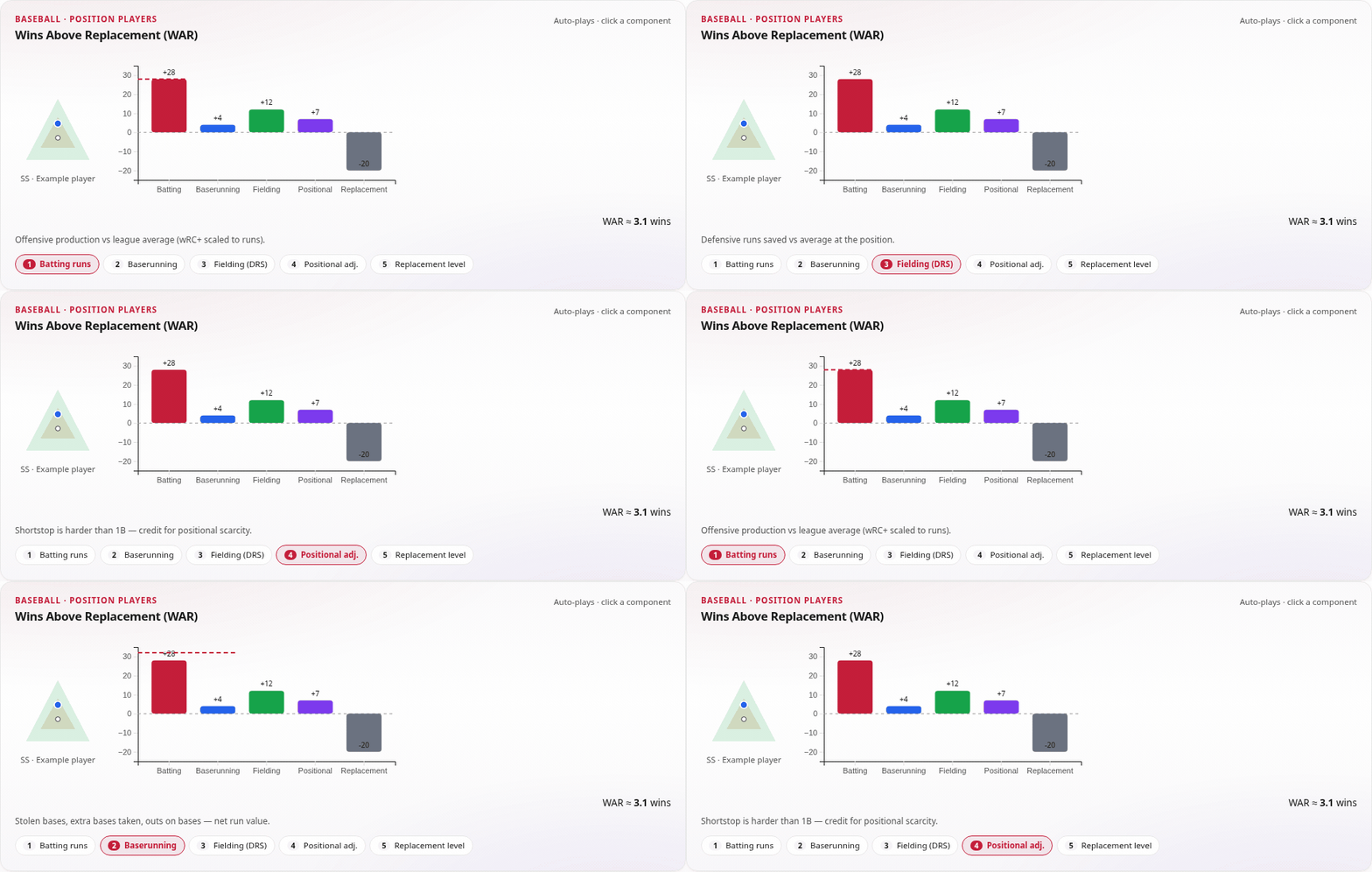
When thinking of WAR and how it would apply in the workplace, it becomes blatantly clear that metrics like lines of code or AI token usage or hours worked is going to lead to inconsistent results. Every person’s performance hinges on another person and for large projects, it can be nearly impossible to tease out. A “win” in the workplace can be as small as being able to hit a deadline on time. But what if the deadline was placed incorrectly? What if the company goes bankrupt regardless of if this deadline is hit?
Is everyone at a failing company, failing at executing in their role?
Wins Above Myself, Win Probability Added, and Internal Signaling
I had a pretty toxic mindset early on in high school all the way through early parts of grad school. It was a lot of external comparisons, especially in things that I viewed as competitions, regardless of if they truly were competitions. And to be clear, it was mostly toxic towards myself. A lot of thoughts along the lines of“why am I not as good as ___?”
Over time, I’ve noticed my mindset has shifted more towards self-oriented questions. Am I better than I was yesterday? Am I doing better than my average from this past year? Was this decision one that I would make next year given the same information? Did I perform worse than my usual?
Effectively, I stopped trying to think of things in terms of other people’s expectations. For the most part, it never really made sense to think of things in those terms; it became especially clear of that during graduate school. After all, even if I lack some arbitrary perfect level of self awareness, I’m surely more aware of a lot of my capabilities than someone who is interacting with me only a few times in a semester.
Lately, I’ve just tried to think about whether I’m adding win probability to the teams I’m on and whether I’m adding as much as I can. Direction and magnitude. It feels a lot less murky in terms of driving what I do on a regular basis, but also it feels a bit more clear what I should focus my efforts and thoughts on. It also becomes clear when I really don’t need to put in more hours.
Now obviously there’s a caveat here and a pretty significant one at that. If I’m not aligned with the team I’m on in terms of what we need to do to win, or if I end up lacking a lot of self-awareness, then I’m doomed to have a terrible performance.
But I think that risk is a bit more acceptable than needing to ask questions about whether my PhD is worth it or if I should give up sleep to try to squeeze a little bit more work out of my exhausted brain.
how do you know if you’re “aligned with your team” and even in an broader sense if you have developed enough self awareness to know if you are “aligned with the team”. i feel like this is probably one of the largest risks you can take on when beginning to work towards anything: if you truly believe that this is something you want to do.